Watch free videos of marine animals like Dolphins, whales, turtles, crocodile,dugongs, fishes, rays, planktons, etc. Enjoy and try to learn about the future source of food for human beings. The videos are added every day keep watching & enjoy! Read more about this animals at this web site http://marineanimalnews.blogspot.com
The divers from the Scuba diving Club "Amphora" carried out the traditional decoration of a Christmas Tree in Ohrid, Makfax's correspondent reported.
"This year, the Christmas Tree was placed in the (river) Crn Drim springs at Sveti Naum monastery and will remain there as a tourist attraction until the New Year's holidays are over," Milutin Sekuloski, international diving instructor, told Makfax Agency.
The underwater Christmas Tree can be seen by taking a boat tour along the springs at Sveti Naum.
"This is our way to extend our best wishes in the new year to the citizens of Ohrid," said the diver Goran Baleski, who played the role of underwater Santa Clause
At the bottom of the ocean, off the coast of Australia, scientists discovered new sea creatures including the Christmas Tree Worm, the Nudi branch sea slug and the tongue-biting isopod.
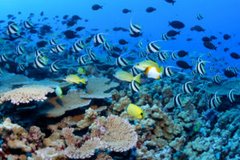
One of Bonaire's more spectacular shore dives. From the four foot jump in at La Dania's, the deep vertical walls and the plunging reef dropoff, to the huge abundance of hard corals; a dive not to be missed. Species seen: Blackbar Soldierfish, Blue Tang, Boulder Star Coral, Brown Chromis, Caribbean Reef Squid, Creole Wrasse, Elkhorn Coral, Fairy Basslet, Fire Coral, Great Barracuda, Green Finger Sponge, Lettuce Sea Slug, Orange Elephant Ear Sponge, Queen Parrotfish, Sea Fan, Smallmouth Grunt, Spanish Hogfish Juvenile, Stoplight Parrotfish, Stove-pipe Sponge, Tang Gang, Tiger Grouper, Touch-me-not Sponge, White Filefish, Yellow Tube Sponge.
In Pemuteran,Bali, scientists, conservationists, hotels, dive shops, fishermen, and villages have gotten together to build coral nurseries on which corals grow faster than normal, and around which fish school. To repopulate the area as quickly as possible with coral and fish, coral nurseries were built using the Electrolytic Mineral Accretion Technology (BiorockTM) of Hilbertz and Goreau. It is an outstanding effort to save corals from manmade destruction by bombs, cyanide fishing and global warming. This is a Dive-tour of the Structures.
Cocos Island rises out of the Pacific Ocean about 550 kms off the coast of Costa Rica. It plays host to an incredible variety and concentration of marine life with more fish per gallon of water than anywhere else on Earth. Come and explore this natural wonder with the Save Our Seas crew as they dive into the unique underwater ecosystem of the island. Part two will be available in two weeks
Most Amazing Documentary by David Attenborough about live in the deep oceans. Filmed in 2003. NOTE: This is NOT Deep Blue Sea or Blue Planet, but the original documentary/movie. It took years to film all this, and it's definitely worth watching!
Take a virtual dive to 200 meters water depth in the Delta submersible and explore marine life and habitats on the offshore banks of Southern California. Researchers at the Southwest Fisheries Science Center's (SWFSC) Fisheries Ecology Division in Santa Cruz conduct visual surveys of fishes, corals, sponges, and other components of deep-sea communities. The information is used to characterize habitats and improve stock assessments for groundfish species.
Learning to scuba dive on the Great Barrier Reed, Australia, back in the year 2000. We had a 1 week training course including 9 dives on a liveaboard which moved between different reefs. Video includes parts of the PADI open water certification including navigation, removing mask. Lots of fish, turtles, corals and other amazing underwater life. Fran is wearing pink fins, and Neil has odd blue and green fins.
New technology allows photographers to capture odd-looking sea life never seen by human eyes.
Ice-covered and isolated, the Arctic Ocean has been stingier with its deepest secrets than any other of Earth's oceans. It might as well be on another planet. Now, armed with a unique set of robotic tools, an international team of scientists is heading there to hunt for life along a little-explored gash in the ocean floor known as the Gakkel Ridge. A decade ago, the project would have seemed quixotic. But since then, scientists have uncovered evidence suggesting that spots along this oddball ridge might be capable of supplying the heat and nutrients to support colonies of creatures that thrive in the pitch-black water thousands of feet below the surface. Once that evidence emerged, the search for basic life in one of the world's most inaccessible places became a must, say several of the scientists involved. The voyage begins July 1.
The expedition also has caught the eye of the National Aeronautics and Space Administration. Techniques for operating autonomous robotic vehicles under ice would be key to exploring below the icy crust of Jupiter's moon Europa.
The voyage is as dicey as any robotic mission NASA has launched to explore the solar system. "This is a very risky venture," says Hanumant Singh, a researcher at the Woods Hole Oceanographic Institution who developed the unmanned undersea vehicles that will negotiate the Gakkel Ridge's icy environs. "I'm prepared to lose a vehicle.... But when you do a risk-versus-benefit analysis, it's absolutely worth it."
A successful voyage hinges on a lot of "ifs and buts," he says. For instance, no one has yet detected evidence of biological activity along the ridge. Yet the deepest parts of the Arctic Ocean -- including the 1,100-mile ridge -- have been isolated from the rest of the world's ocean floors for up to 65 million years. If organisms exist around Arctic hydrothermal vents, "then the very basis of life there has been evolving independently for tens of millions of years," he says.
Interest in sampling the bottom of the ocean at the top of the world has been building since the end of the cold war, when US and Soviet nuclear submarines stalked each other under the ice. In 1995, the US Navy allowed marine scientists to charter Arctic-capable nuclear attack submarines for research in a five-year program called Scicex. Among its achievements, Scicex developed the most detailed maps of the Arctic Ocean floor yet available. During the program's final cruise in 1999, scientists aboard the USS Hawkbill were mapping the Gakkel Ridge when they picked up evidence of a recent volcanic eruption.
Two years later, scientists returned to the ridge aboard USCGC Healy, a Coast Guard icebreaker dedicated to polar research, and the German icebreaker Polarstern. The main objective was to dredge for rocks along the ridge to better understand its geology. But the team also was interested in spotting any hydrothermal activity along the ridge. So scientists fastened sensor packages to the dredge cables and added hydrothermal-vent specialist Henrietta Edmonds to the team to interpret the data the sensors captured.
Mid-oceanic ridges supply the planet with new crust, which spreads outward from the line of volcanoes and rift valleys they form. Gakkel has the slowest spreading rate of them all. Based on studies of spreading rates and hydrothermal activity, researchers suspected Gakkel was too cool to host much hydrothermal activity.
"I'm probably not going to find anything," Dr. Edmonds recalls thinking at the time. Among the primary targets for the 2001 cruise: the region the Hawkbill mapped as a likely eruption location. There, Edmonds and her colleagues hit pay dirt. "We found this monster hydrothermal plume about 1,000 meters off the bottom and 1,000 meters thick." The plume, more than half a mile thick, had all of the telltale chemical traits of major eruptive plumes along other mid-oceanic ridges. Meanwhile, colleagues aboard the Polarstern were detecting sound waves from what they interpreted as a series of eruptions. Instead of plume leftovers from 1999, the team probably was sampling a plume being generated on the spot, says Edmonds, a marine chemist at the University of Texas at Austin and a lead scientist on this year's cruise.
In 2003, Edmonds and her colleagues published the results of the Healy/Polarstern cruise, showing that the Gakkel Ridge hosted far more hydrothermal activity than expected. She estimates that the ridge hosts perhaps 10 areas of hydrothermal activity that dot roughly 600 miles of the ridge -- a modest number. But the 2001 cruise observed hydrothermal plumes more frequently over Gakkel than over three other major -- and faster spreading -- ridges.
This year's expedition, which carries a price tag of at least $3 million, will run 50 days from the time the Swedish icebreaker Oden weighs anchor July 1 to the time it returns to its port. Two autonomous vehicles, Jaguar and Puma, will map the floor and analyze water samples. A tethered vehicle, dubbed the Camper, can take images as well as snag samples of clams or shrimp from the sea floor. The ability to bring sea-creature samples to the surface is critical, Dr. Singh says. Photos are valuable, "but a clam is just a clam until you analyze its DNA."
The discovery of life at inhospitable hydrothermal vents 30 years ago forced many biologists to expand their thinking about the range of environments that could support life. "One of the things that's really exciting about this is that we are going somewhere that absolutely no one else has ever been," says Susan Humphris, a scientist at Woods Hole and expedition member


 Posts
Posts


 Seed Newsvine


