CORAL REEF RESTORATION THROUGH CORAL TRANSPLANTATION
CORAL REEF RESTORATION THROUGH CORAL TRANSPLANTATION: THE CASE OF DUKA BAY,MEDINA,MISAMIS ORIENTAL, PHILIPPINES
CORAL REEF RESTORATION THROUGH CORAL TRANSPLANTATION: THE CASE OF DUKA BAY,MEDINA,MISAMIS ORIENTAL, PHILIPPINES
This is a lovely wall dive on Northwest Point of Providenciales. The vertical wall is covered with wire coral, black coral and sponges. The shallows at the top of the wall are covered with hard and soft corals and sponges. What made this particular dive enjoyable was the Caribbean octopus we found toward the end of the dive that was escorted by two Nassau groupers. The octopus hung out with us until we had to return to the boat.
Scientists completed a 64-day cruise to the Northwestern Hawaiian Islands, onboard the University of Hawaii's Research Vessel, Ka'imikai-o-Kanaloa, and the Pisces IV and V Submersibles. They studied the regions virtually unexplored deep-sea corals, submarine canyons, and seamounts. One objective was to learn how endangered Hawaiian monk seals use shallow and deep-water habitats for hunting and protection. When scientists dove to a deep-sea coral bed, they were shocked to see an endangered Hawaiian monk seal at an amazing depth of 543 meters (1781 feet).
It's the first time a monk seal was documented as associated with deep-sea precious corals, and the first time a monk seal was observed at such a depth, where he showed no sign of stress.
The Tubbataha reefs, in the center of the Sulu Sea,
are one of the richest areas of marine bio-diversity in the world.
This reef has one of the largest assemblages of marine life
Per unit area in the world.The reef has been declared a National Marine Park
and a UNESCO World Heritage Site
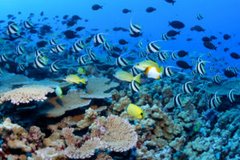
Area fish mingle near Prickly Pear island. (french grunt, gray angelfish, longspine squirrelfish, juvenile stoplight parrotfish, elkhorn coral, mixed school of fish, parrotfish, blue chromis, sea plants, coral rubble, trumpetfish, elkhorn coral, smooth trunkfish, redlip blenny, coral rubble, elkhorn coral, parrotfish, juvenile queen parrotfish, grouper (?), seafan, blue chromis, parrotfish, yellowhead jawfish, blue chromis, coral rubble).
In Pemuteran,Bali, scientists, conservationists, hotels, dive shops, fishermen, and villages have gotten together to build coral nurseries on which corals grow faster than normal, and around which fish school. To repopulate the area as quickly as possible with coral and fish, coral nurseries were built using the Electrolytic Mineral Accretion Technology (BiorockTM) of Hilbertz and Goreau.
It is an outstanding effort to save corals from manmade destruction by bombs, cyanide fishing and global warming.
Bubblegum trees and red tree coral from Georges Bank Nova Scotia. Never eat fishsticks to save coldwater corals.
In our video we described a tropical underwater ecosystem, specifically focusing on the coral reef species. We first looked at what type of environment this species lived in, explaining the climate and diversity in the area. By highlighting the importance of nutrient cycling in nutrient poor waters, we showed the coral reef and other reef organism's importance to the biome. We then elaborated on some of the threats that face the coral reef species, including both human and animal activities. Finally, we showed that there is hope for the coral reef, demonstrating the species interaction between the shark and the coral, and how the shark actually helps the coral thrive.
The elkhorn coral, Acropora palmata, has been a major reef-building coral in the Caribbean for the last 220,000 years. However, since the ... all » early 1970's, the dominance of this species within the reef system has declined dramatically (McClanahan & Muthiga, 1998). The decline of A. palmata can be attributed to two diseases: White Band and White Pox Disease. The following footage shows a patch of A. palmata covered with large lesions characteristic of White Pox (Patterson, et al., 2002). It has been demonstrated that this disease is caused by Serratia marcescens, a bacterial Mini-Documentaries Short Movies Home Cniderian Aggression Living In Groups Reef Dynamics Reproduction Sharks and Rays Shifting Baselines Stressed Corals Symbioses Threats To Reefs Visual Biology and Mimicry The elkhorn coral, Acropora palmata, has been a major reef-building coral in the Caribbean for the last 220,000 years. However, since the early 1970’s, the dominance of this species within the reef system has declined dramatically (McClanahan & Muthiga, 1998). The decline of A. palmata can be attributed to two diseases: White Band and White Pox Disease. The following footage shows a patch of A. palmata covered with large lesions characteristic of White Pox (Patterson, et al., 2002). It has been demonstrated that this disease is caused by Serratia marcescens, a bacterial pathogen associated with human sewage (Patterson et al. 2002). Credits Cinematography: Neilan Kuntz Edited by: Neilan Kuntz Written by: Dr. Olga Pantos Location: Bocas del Toro, Panama (2003) McClanahan, T.R. and N.A. Muthiga (1998) Ecological shift in a remote coral atoll of Belize over 25 years. Environmental Conservation 25(2): 122-130. Patterson, K., J. Porter, et al. (2002) The etiology of white pox, a lethal disease of the Caribbean elkhorn coral, Acropora palmata. Proceeding of the National Academy of Science 99 (13): 8725-8730.
This footage looks at the disease outbreaks that occured during the bleaching event of 1997 at Sand Key Reef near Key West
Scripps scientists are studying how changing environmental conditions are affecting coral reef habitats, and what the future may hold.
Learning to scuba dive on the Great Barrier Reed, Australia, back in the year 2000. We had a 1 week training course including 9 dives on a liveaboard which moved between different reefs. Video includes parts of the PADI open water certification including navigation, removing mask. Lots of fish, turtles, corals and other amazing underwater life. Fran is wearing pink fins, and Neil has odd blue and green fins.
As part of our Dive into Earth Day activities this is Reef Check Australia's underwater promotional video featuring John Butler's "Ocean" and footage by Digital Dimensions. If you care about the future of these natural wonders please sign Reef Check's International Declaration of Reef Rights and join our global network who are committed to the conservation of our coral reefs!!! www.reefcheckaustralia.org
Divers: get trained as a volunteer
Snorkellers: Use our underwater guides
Reef lovers: donate or purchase merchandise
The Reef Needs You.....
Special Thanks to the John Bulter Trio who generously who gifted this sound track and the Australasian Natural History Unit who donated the stunning visuals..... Sit back relax and enjoy
Corals have two types of reproduction – sexual and asexual. It is the sexual reproduction that results in the formation of a new genetically different offspring and reproduction, producing clones within a colony. Coral have two strategies for sexual reproduction- broadcast and brooding. Brooding species release the male gametes into the water column. When the gametes come in contact with the surface of a colony of the same species they are absorbed into the tissues were fertilization of the female gametes occurs. The fertilized eggs develop into a planulae larva. Once fully developed the planulae leave the parent colony and become planktonic before eventually settling on a suitable substrate and growing, forming a new genetically distinct colony. In contrast, broadcast spawning corals, as shown in this video, release both male and female gametes into the water at the same time. Only viable for a couple of hours, the density and timing of gametes released is critical to maximize the probability of successful fertilization in the water (Oliver & Babcock 1992). Positively buoyant, these gametes float to the surface and can form slicks on the surface of the water. These slicks can be seen from low flying aircraft. Once fertilization has occurred, the planulae may remain planktonic for up to thirty days. Mass spawning of different species can occur during the same day. A timing divergence of a couple hours however, may occur and is vital for reproduction isolation (Knowlton et al. 1997). In the case of the Montastraea species complex, differences in gamete release times appears responsible for the speciation between closely related reproductive sibling species Montastraea annularis, Montastraea franksi, and Montastraea faveolata (Levitan et al. 2004). This video sequence shows the release of gametes from a broadcast spawning event.
More than a million years ago tiny marine organisms began laying the foundations of the Meso-American Reef, a long spine of coral hugging ... all » the shore of present-day Mexico, Belize, Guatemala and Honduras.
Through the ages their fanciful castles, spires and grottoes grew taller and bigger with each wave of calcium carbonate and skeleton laid down by coral polyps, coralline algae, tube worms and mollusks. Their construction continues to this day, making the Meso-American Reef the second largest coral reef in the world after Australia's Great Barrier Reef.
To learn more about this magical place and the work that The Nature Conservancy is doing there, check out this video clip.
The Great Barrier Reef has the highest diversity of life of any of the reef systems in the world. With its 1,600 different species of fish, 6000 species of crustaceans, 4000 species of molluscs, turtles, whales and dolphins, the reefs are a kaleidoscope of animal colour and shape.
The Great Barrier Reef does not contain the greatest variety of marine life on the planet. Explore a single reef in Indonesia that contains ... all » almost as many kinds of fish as you would find in the entire Caribbean and ten times the species of Caribbean coral.

 Posts
All Comments
Posts
All Comments


get your job site
at simplyhired.com


 Zool
ogy & RSS feeds
Search Engine Web Directory categorized by subject. eSearchLogic is a directory focused on family friendly results in our directory listings.
Zool
ogy & RSS feeds
Search Engine Web Directory categorized by subject. eSearchLogic is a directory focused on family friendly results in our directory listings.

 FeedPublish


 Seed Newsvine


