Showing posts with label Coral bleaching. Show all posts

Wednesday, November 26, 2008

CHRISTMAS SPECIAL!!! 2008 on Videos TROPICAL FISH CORAL


CHRISTMAS SPECIAL!!! 10.00 OFF on Videos TROPICAL FISH CORAL


The growing appetite for coral and other reef organisms has begun to take a toll on wild populations and rare marine ecosystems. 2,3,8


Coral reefs are deteriorating globally at alarming rates. Ten percent of the reefs have already been lost and sixty percent are threatened. Coral reefs provide a home for one quarter of all marine species. 1,2,7
CHRISTMAS SPECIAL!!! 10.00 OFF on Videos TROPICAL FISH CORAL

The mortality rate of coral harvested for aquariums is close to one hundred percent. Many die from damage during collection or shipping while others perish through lack of skill or knowledge of the aquarist. 2,4,6,7,8


Ninety percent of the animals in the marine aquarium market are captured wild. Studies show that up to two-thirds of the fish were dead in six months. Twenty-seven percent died in collection, transit or storage in pet stores, the rest in home or public aquariums. 3,5

CHRISTMAS SPECIAL!!! 10.00 OFF on Videos TROPICAL FISH CORAL
Cyanide is still being used to catch live fish. Cyanide not only poisons the fish, but also destroys their habitat, killing coral polyps and their symbiotic algae, as well as other small organisms necessary for healthy reefs. 3,7
HOLLY JOLLY CHRISTMAS Lyrics
Wods and Music by Johnny Marks

Have a holly jolly Christmas;
It's the best time of the year,
I don't know if there'll be snow,
but have a cup of cheer.
Have a holly jolly Christmas,
And when you walk down the street,
Say hello to friends you know and ev'ryone you meet.
Oh, no, the mistletoe hung where you can see;
Somebody waits for you;
Kiss her once for me.
Have a holly jolly Christmas,
and in case you didn't hear,
Oh, by golly, have a holly jolly Christmas this year.
Oh, ho, the mistletoe hung where you can see;
Somebody waits for you;
Kiss her once for me.
Have a holly jolly Christmas,
and in case you didn't hear,
Oh, by golly, have a holly jolly Christmas this year.
CHRISTMAS SPECIAL!!! 10.00 OFF on Videos TROPICAL FISH CORAL

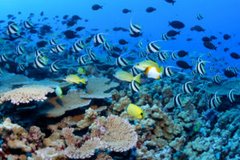
Coral Bleaching in the Philippines


Solar Generation in the Philippines presenting coral bleaching problem.

Thursday, December 6, 2007

New reef for Red Sea


Divers plant an artificial reef to protect the natural ones from divers at the Israeli Red Sea resort of Eilat.

Intensive diving is damaging the resort's natural reefs which form some of the world's most diverse coral communities and experts are hoping the new artificial version will solve the problem.

Paul Chapman reports.

Friday, October 19, 2007

Slideshow of Structures,Nov.2005,Part 2 Coral reef conservation


In Pemuteran,Bali, scientists, conservationists, hotels, dive shops, fishermen, and villages have gotten together to build coral nurseries on which corals grow faster than normal, and around which fish school. To repopulate the area as quickly as possible with coral and fish, coral nurseries were built using the Electrolytic Mineral Accretion Technology (BiorockTM) of Hilbertz and Goreau.
It is an outstanding effort to save corals from manmade destruction by bombs, cyanide fishing and global warming.
This is a Dive-tour of the Structures.
Part 2 of 2

Slideshow of Structures,Nov.2005,Part 1 coral reef conservation


In Pemuteran,Bali, scientists, conservationists, hotels, dive shops, fishermen, and villages have gotten together to build coral nurseries on which corals grow faster than normal, and around which fish school. To repopulate the area as quickly as possible with coral and fish, coral nurseries were built using the Electrolytic Mineral Accretion Technology (BiorockTM) of Hilbertz and Goreau.
It is an outstanding effort to save corals from manmade destruction by bombs, cyanide fishing and global warming. This is a tour of the Structures.

Diving Structures, April 2005, Part 2 coral reef conservation


In Pemuteran,Bali, scientists, conservationists, hotels, dive shops, fishermen, and villages have gotten together to build coral nurseries on which corals grow faster than normal, and around which fish school. To repopulate the area as quickly as possible with coral and fish, coral nurseries were built using the Electrolytic Mineral Accretion Technology (BiorockTM) of Hilbertz and Goreau.
It is an outstanding effort to save corals from manmade destruction by bombs, cyanide fishing and global warming.
This is a Dive-tour of the Structures.

Diving Structures, April 2005, Part 1 Coral reef conservation


In Pemuteran,Bali, scientists, conservationists, hotels, dive shops, fishermen, and villages have gotten together to build coral nurseries on which corals grow faster than normal, and around which fish school. To repopulate the area as quickly as possible with coral and fish, coral nurseries were built using the Electrolytic Mineral Accretion Technology (BiorockTM) of Hilbertz and Goreau.
It is an outstanding effort to save corals from manmade destruction by bombs, cyanide fishing and global warming.
This is a Dive-tour of the Structures.

Karang Lestari coral reef conservation


In Pemuteran,Bali, scientists, conservationists, hotels, dive shops, fishermen, and villages have gotten together to build coral nurseries on which corals grow faster than normal, and around which fish school. To repopulate the area as quickly as possible with coral and fish, coral nurseries were built using the Electrolytic Mineral Accretion Technology (BiorockTM) of Hilbertz and Goreau.
It is an outstanding effort to save corals from manmade destruction by bombs, cyanide fishing and global warming.

Friday, September 7, 2007

White Pox Disease

The elkhorn coral, Acropora palmata, has been a major reef-building coral in the Caribbean for the last 220,000 years. However, since the ... all » early 1970's, the dominance of this species within the reef system has declined dramatically (McClanahan & Muthiga, 1998). The decline of A. palmata can be attributed to two diseases: White Band and White Pox Disease. The following footage shows a patch of A. palmata covered with large lesions characteristic of White Pox (Patterson, et al., 2002). It has been demonstrated that this disease is caused by Serratia marcescens, a bacterial Mini-Documentaries Short Movies Home Cniderian Aggression Living In Groups Reef Dynamics Reproduction Sharks and Rays Shifting Baselines Stressed Corals Symbioses Threats To Reefs Visual Biology and Mimicry The elkhorn coral, Acropora palmata, has been a major reef-building coral in the Caribbean for the last 220,000 years. However, since the early 1970รข€™s, the dominance of this species within the reef system has declined dramatically (McClanahan & Muthiga, 1998). The decline of A. palmata can be attributed to two diseases: White Band and White Pox Disease. The following footage shows a patch of A. palmata covered with large lesions characteristic of White Pox (Patterson, et al., 2002). It has been demonstrated that this disease is caused by Serratia marcescens, a bacterial pathogen associated with human sewage (Patterson et al. 2002). Credits Cinematography: Neilan Kuntz Edited by: Neilan Kuntz Written by: Dr. Olga Pantos Location: Bocas del Toro, Panama (2003) McClanahan, T.R. and N.A. Muthiga (1998) Ecological shift in a remote coral atoll of Belize over 25 years. Environmental Conservation 25(2): 122-130. Patterson, K., J. Porter, et al. (2002) The etiology of white pox, a lethal disease of the Caribbean elkhorn coral, Acropora palmata. Proceeding of the National Academy of Science 99 (13): 8725-8730.

Coral Bleaching and Coral Disease


This footage looks at the disease outbreaks that occured during the bleaching event of 1997 at Sand Key Reef near Key West