Showing posts with label Deep sea. Show all posts

Thursday, July 10, 2008

Deep sea wonders


Of course, the marine-life depicted in this movie are not Alien Fish, even though they might appear so, to many of us. Simply, things are "alien" until they are identified and named, then it becomes almost ordinary. Many of the deep-sea fish seen are called Viperfish, Lizardfish, Whalefish and Dragonfish, though they have more technical names of course and are found at the oceans depths. Some create their own light, as seen, and all can survive at unbelievable water pressures.

The giant carcasses that resemble a loch ness monster are anyone's guess...Often the so-called experts claim that they're just regular (whales for example) that appear this strange way after they decompose though I highly doubt that. Yet once again, until they can find a live specimen, then name it, that strange aquatic organism will not exist to most people. I guess they cannot get their minds around it, while the unknown frightens most. Second, Cthulhu, the giant, squid-faced and winged sea monster was written about by H.P Lovecraft in a series of stories known as the Cthulhu mythos. Cthulhu. It is an ancient, demonic, aquatic beast worshipped by a secret cult, and "trapped" inside a tomb in an ancient rock city, now underwater. The city is described in length as not have been built by or for humans because the steps are too vast and the architecture too strange. This brings us to the photographs taken of the underwater ruins, found off the coast of Japan, I believe, which are also immense and eerily similar to the underwater, rock city described by Lovecraft in The Call of Cthulhu, etc.

Since we, as people, are only familiar with the smallest percentage of the world (being the surface) we are therefore "in the dark" about a vast amount of the world we live in. As proven, life can live in the harshest of environments, and new species of organisms are found all the time. Scientists will even admit that we are not even close to identifying all the species on the planet, not to mention inside the planet.

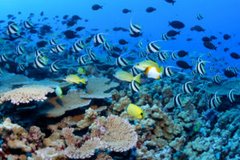
Deep sea creatures

Saturday, May 10, 2008

Underwater Creature Camouflage


Learn how denizens of the deep stay hidden and mimic other creatures.

Wednesday, March 12, 2008

Continental breakup sea floor


An integrated approach to continental breakup: insights from central Ethiopia

San Diego State University Department of Geological Sciences Seminars Webinar Series

Dr. Tyrone Rooney San Diego State University Department of Geological Sciences

The East African Rift system is the archetypal example of continental rupture and has global significance in understanding extensional plate tectonic processes. We concentrate on the central Main Ethiopian Rift, which lies between the thicker continental crust in Southern Ethiopia and the thin predominately basaltic crust of the Afar Depression. We utilize Quaternary basaltic lavas erupted in tectono-magmatic fault belts to probe the source of rift magmatism and establish a connection between deeper mantle processes ( e.g. mantle plumes) and continental rifting. This study has also focussed on the relationship between magmatic intrusion in the continental lithosphere and extension. These geochemical results are combined with geophysical studies to produce an integrated geodynamic model for the progression of continental rifting along the Main Ethiopian Rift and call into question the concept of a simple transition between continental rifts and sea floor spreading centers.

Sea floor through satellite


Overview of the GLORIA Project. This image acquisition and mapping project covers the EEZ, or Exclusive Economic Zone, a 200 mile wide ... all » area

of the ocean extending out from the coast of all U. S. territories and possessions. The video shows the quality of the imagery and how it was acquired and used to locate sea floor faults and submarine landslides.United States Geological Survey

Arctic Sea Floor


As part of an NSF-funded collaboration with Woods Hole Oceanographic Institution and science centers across the country to increase awareness of polar research and Earth's polar regions

Friday, December 14, 2007

Monk Seal at 1781 feet


Scientists completed a 64-day cruise to the Northwestern Hawaiian Islands, onboard the University of Hawaii's Research Vessel, Ka'imikai-o-Kanaloa, and the Pisces IV and V Submersibles. They studied the regions virtually unexplored deep-sea corals, submarine canyons, and seamounts. One objective was to learn how endangered Hawaiian monk seals use shallow and deep-water habitats for hunting and protection. When scientists dove to a deep-sea coral bed, they were shocked to see an endangered Hawaiian monk seal at an amazing depth of 543 meters (1781 feet).

It's the first time a monk seal was documented as associated with deep-sea precious corals, and the first time a monk seal was observed at such a depth, where he showed no sign of stress.

Deep Sea Deep Space


Who can honestly look at the wonders of our world and our universe and say it...
'...it just happened!

Sunday, August 26, 2007

BBC's Deep Blue part 4


Most Amazing Documentary by David Attenborough about live in the deep oceans. Filmed in 2003. NOTE: This is NOT Deep Blue Sea or Blue Planet, but the original documentary/movie. It took years to film all this, and it's definitely worth watching!

Sunday, July 8, 2007

Blue Planet - The Deep


Captures from The Deep, Part of the BBC's The Blue Planet series.

The Blue Planet-Frozen Seas


Life on the edge of a frozen sea is tough. Pack ice at both poles is constantly on the move, and in winter freezes solid with air temperatures 70 degrees Celsius below freezing. Only in spring, with the retreating ice and light reaching the water, does life begin again. Plankton blooms and feeds vast hordes of migrating fish, birds, whales, seals and polar bears. Walruses rake the seabed for clams. Minke and humpback whales gorge themselves on gigantic swarms of krill. But it is a brief indulgence, for the ice soon returns and pushes life back into the ocean

Saturday, June 23, 2007

BBC PLANET EARTH - Ocean Deep


Life goes to extraordinary lengths to survive this immense realm. A 30 tonne whale shark gorges on a school of fish and the unique overhead heli-gimbal camera reveals common dolphins rocketing at more than 30km an hour. Descending into the abyss, deep sea octopus fly with wings and vampire squid use bioluminescence to create an extraordinary colour display. The first ever time-lapse footage taken from 2,000m down captures eels, crabs and giant isopods eating a carcass, completely consuming it within three hours

Wednesday, April 4, 2007

Life around deep sea methane seeps 2


This video clip shows a community of cold seep organisms at a site in the Cook Strait, New Zealand. The footage was captured by researchers from the National Institute of Water and Atmospheric Research, New Zealand, and the Woods Hole Oceanographic Institute, US. Read more about the expedition on http://www.newscientist.com/article/d...

Life around deep sea methane seeps


Organisms at a site on the Hikurangi Margin off the east coast of New Zealand at a depth of about 1000 metres. The footage was captured by researchers from the National Institute of Water and Atmospheric Research, New Zealand, and the Woods Hole Oceanographic Institute, US.Read more about the expedition on http://www.newscientist.com/article/d...

Thursday, March 22, 2007

Deep Sea Creatures


See what lives in the deep sea

Friday, February 9, 2007

Blue Planet - The Deep Sea Part 2


Part two of the Blue Planet to the deep sea

The Blue Planet - Deep Sea Part.1


An immensely fascinating BBC documentary about the creatures that live thousands of feet beneath the waves.